Honey bees or yellow jackets?
This is the single most common question we get, and it matters more than almost anything else you could ask us. One of these gets rescued. The other gets exterminated. Honey bees come out alive and go to a working apiary — and if it's a swarm, that's free. Yellow jackets are wasps, and they're a pest control job. Telling them apart takes about ten seconds once you know what to look at.
Fuzzy and soft, or shiny and sharp
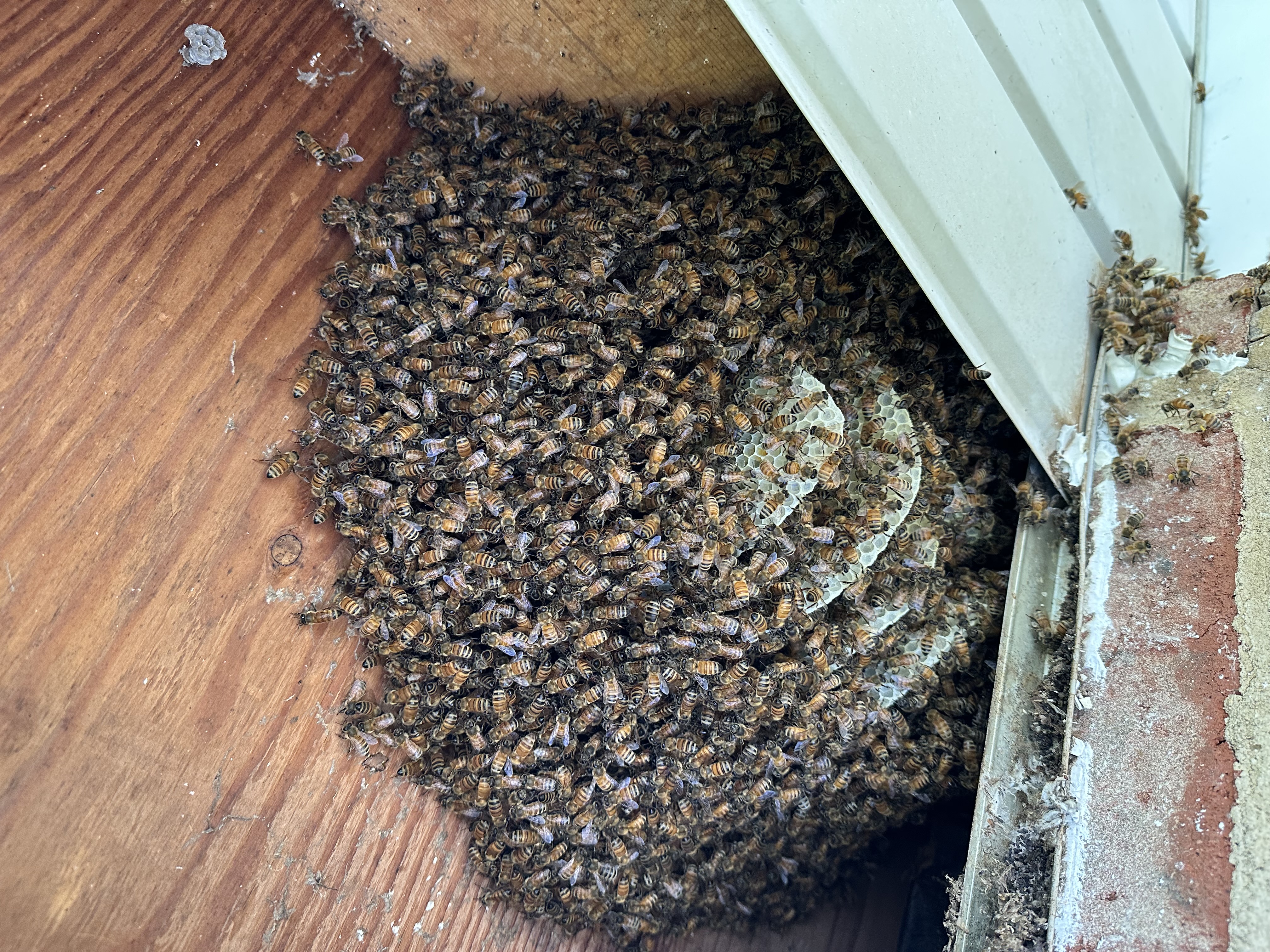
Honey bee: fuzzy all over, amber and brown, soft-looking, with muted and slightly blurry banding. Broad-waisted and a bit chunky. Often carrying visible lumps of pollen on the back legs. Flight is heavy and purposeful — they're going somewhere.
Yellow jacket: smooth, shiny, almost lacquered, with hard-edged bright yellow and glossy black. Obvious narrow waist. Never carrying pollen. Flight is quick and darting, and they hover to investigate you.
If you had to remember one word for each: honey bees are fuzzy, yellow jackets are shiny.
Put a can of Coke on the table
Forget the insect for a second and watch the behaviour, because this one is nearly foolproof in late summer. Yellow jackets come to your food. Soda, beer, hamburger, lunch meat, the rim of your glass, the trash can. They'll land on the can and crawl inside it, which is how people get stung on the lip.
Honey bees have no interest in any of that. They eat nectar and pollen. A honey bee will visit clover in your lawn and completely ignore the picnic table two feet away. If something is fighting you for your sandwich at a September cookout in Harrisburg, it is not a honey bee — no exceptions worth mentioning.
The one thing that will draw honey bees to a table is an open jar of honey or a sugary spill in early spring when nothing is blooming. Rare, and not what's happening at your barbecue.
Wax means bees. Paper means wasps.
If you can see the structure, this is the most reliable evidence there is — and you don't need to get close.
- Waxy honeycomb. Flat vertical sheets of pale yellow to brown comb with hexagonal cells, often with honey visible and glistening. That's a honey bee colony, and it's a live removal.
- Grey paper. Chewed wood fibre with a papery, layered look — either an enclosed grey football hanging in the open, or hidden combs tucked in a cavity. That's yellow jackets or hornets.
- A bare clump of bees and no structure at all. A football-sized ball of insects hanging on a branch with nothing built around it is a honey bee swarm. Wasps don't do this. Collection is free, and the clock is running.
- Nothing visible, just traffic into a hole. Then go by the insect and the season — or send us a photo and let us do it.
The calendar does half the work
Late April through June is swarm season in Central PA. This is when honey bee colonies split and a cluster of bees turns up hanging in a tree, on a fence, or under a porch rail. If you're looking at a ball of bees in May, it's a swarm, and we want to hear from you today.
August through October is when yellow jacket colonies peak. They've been quietly building all summer and suddenly there are thousands of them, they're out of natural food, and they're at your cookout. Almost every "bee problem" in September is yellow jackets.
Honey bees are active the whole season and don't spike like that. If the problem appeared suddenly in late summer and is getting worse weekly, that's a wasp pattern.
It might not be either one
- Bumble bee. Big, round, and extremely fuzzy, often with bold yellow banding. Nests in the ground, in old mouse burrows, under sheds. Docile, important, in decline — and best left alone. They die off naturally each autumn.
- Carpenter bee. Bumble-bee sized but with a shiny bald black abdomen. Hovers in your face on the deck. Drills perfectly round half-inch holes in bare wood. The hovering ones are males and physically cannot sting.
- Bald-faced hornet. Large, black and white rather than yellow, and builds that grey enclosed football in a tree or under an eave. A wasp, and the most defensive one we have around here.
- Paper wasp. Slim, long-legged, dangles its legs in flight. Builds a small open umbrella of cells under a railing or a grill lid. Much milder than the rest.
Why the answer changes the bill
If it's honey bees, they come out alive. A swarm clustered in the open is a free collection — we get a colony, you get them gone, everybody wins. A colony established inside a structure is a genuine removal job with comb and honey to extract, and that's quoted properly, but they still leave alive and go to one of our apiaries. We do not exterminate honey bees, ever.
If it's yellow jackets, hornets, or wasps, that's a pest control job rather than a beekeeping one. Our sister company, Lawns Plants & Pests, handles it — same family, same phone number, and a licensed PA applicator. Ground nests, nests in siding, and aerial hornet nests all get priced up front.
That arrangement is the reason we can be honest with you about which one you have. We're not trying to talk you into a removal or out of one — the same phone number handles either answer.
Common questions
I got stung several times by the same insect. What does that tell me?
Almost certainly a wasp. A honey bee's sting is barbed — she can generally only sting once and it kills her, so honey bees don't sting repeatedly and don't do it casually. Yellow jackets and hornets have smooth stingers and will sting over and over. Repeated stings from one insect is close to conclusive.
There's a stinger left in my skin. Bee or wasp?
A stinger and venom sac left behind is a honey bee. Scrape it out sideways rather than pinching it, which squeezes in more venom. Wasps almost never leave the stinger. If there's swelling beyond the sting site, trouble breathing, or dizziness, call 911 first.
They're going in and out of a hole in the ground. Which is it?
Usually yellow jackets — honey bees rarely nest in the ground, though it does happen in old rodent burrows and hollow stumps. The tell is traffic and temperament: one hole with heavy fast traffic that gets aggressive when you're near is yellow jackets. Send a photo before anyone treats anything. See ground bees for the full rundown.
Someone told me to spray them and see what happens.
Please don't. If they're honey bees you've killed a colony that we'd have taken away for free, and a dead colony inside a wall leaves pounds of honey and wax behind that ferments, seeps through drywall, and draws other pests. If they're wasps, hardware-store spray into a cavity usually just makes them angry. Either way the photo costs nothing.
I really can't tell and I don't want to get close.
Then don't — that's exactly what we're for. Photograph it zoomed in from a safe distance, or take a short video, and text it to 717-379-3248 with your town. We do this all day in swarm season and most of the autumn, and the answer is free either way.
Send us a photo and we'll tell you.
Free identification across Harrisburg, Hershey, Camp Hill, Mechanicsburg, Carlisle, Palmyra, and Central PA. If it's honey bees we'll come get them alive. If it's wasps we'll tell you that instead — and you'll know before anyone charges you anything.
Call or Text 717-379-3248