Live honey bee removal in Harrisburg, PA
The Alleman Apiary is a working beekeeping operation based in Harrisburg. We collect honey bee swarms and remove established colonies from homes, businesses, and farms throughout Central PA — and every bee we collect goes home to one of our managed apiaries. We don't exterminate honey bees — we relocate them. We're beekeepers who answer the phone, show up the same day during swarm season, and add your bees to our hives.
Is it free? Only if it's a swarm.
A swarm
A ball of bees hanging out in the open, on a branch, fence, or car. No nest, no comb. It shows up all at once and leaves on its own in 1–3 days. Almost always April through July.
Swarm collection →Honey bees living in your house
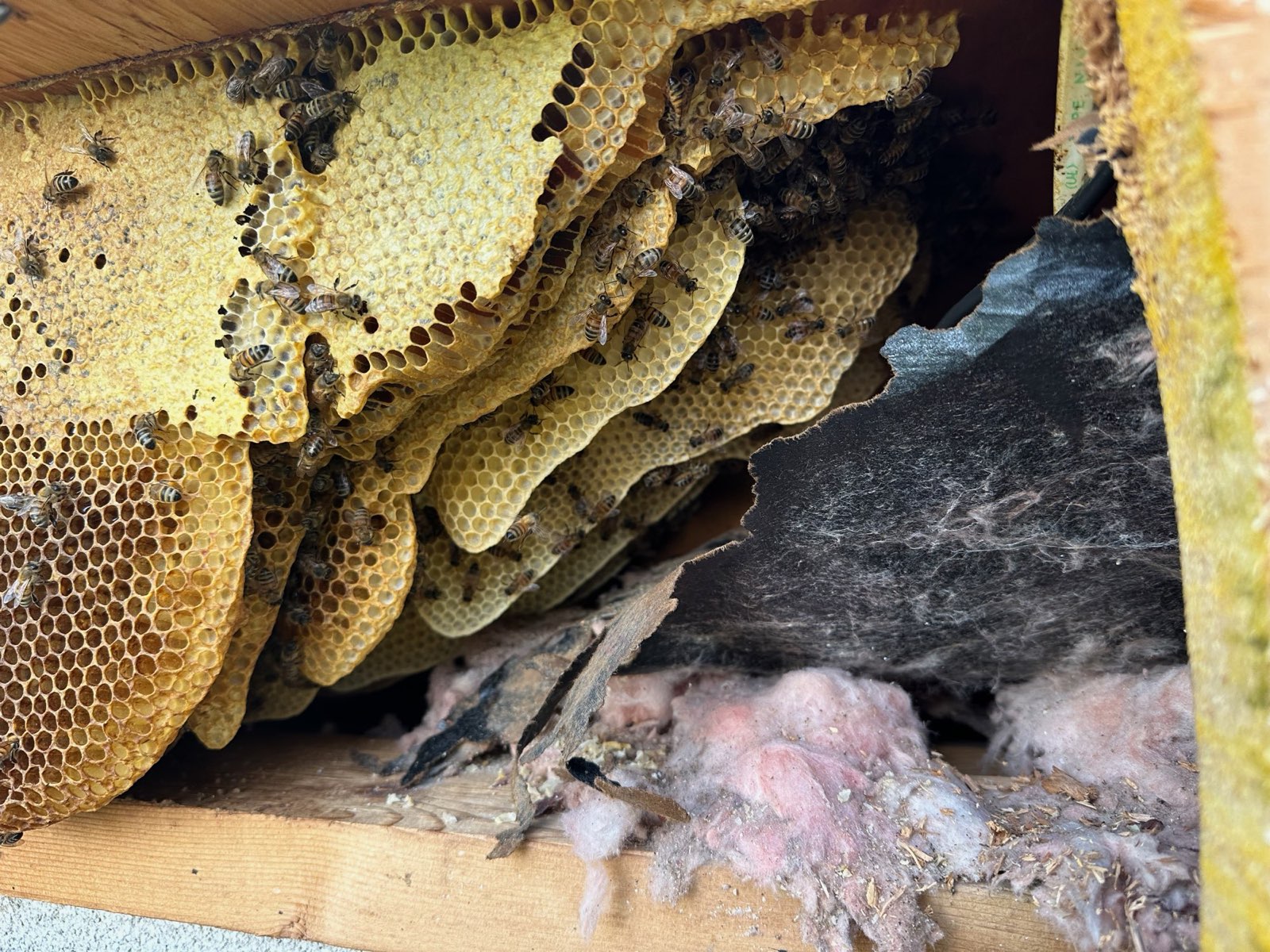
Bees going in and out of one hole in a wall, soffit, or chimney, day after day. That's a colony that has moved in and built comb and honey inside. It has to be cut out, so it's a removal job. The bees still leave alive.
Live bee removal →Yellow jackets, hornets & wasps
Shiny, fast, and after your food and drinks. Nests in the ground, in a wall, or in a grey paper ball. Worst from August through October. That's pest control, done by our sister company Lawns Plants & Pests.
Yellow jacket removal →Seeing bees go in and out of a hole in late summer or fall? That's almost never a swarm, and usually yellow jackets. Text a photo to 717-379-3248 and we'll tell you which one you have.
If you see honey bees
A cluster hanging in a tree, fence, or building
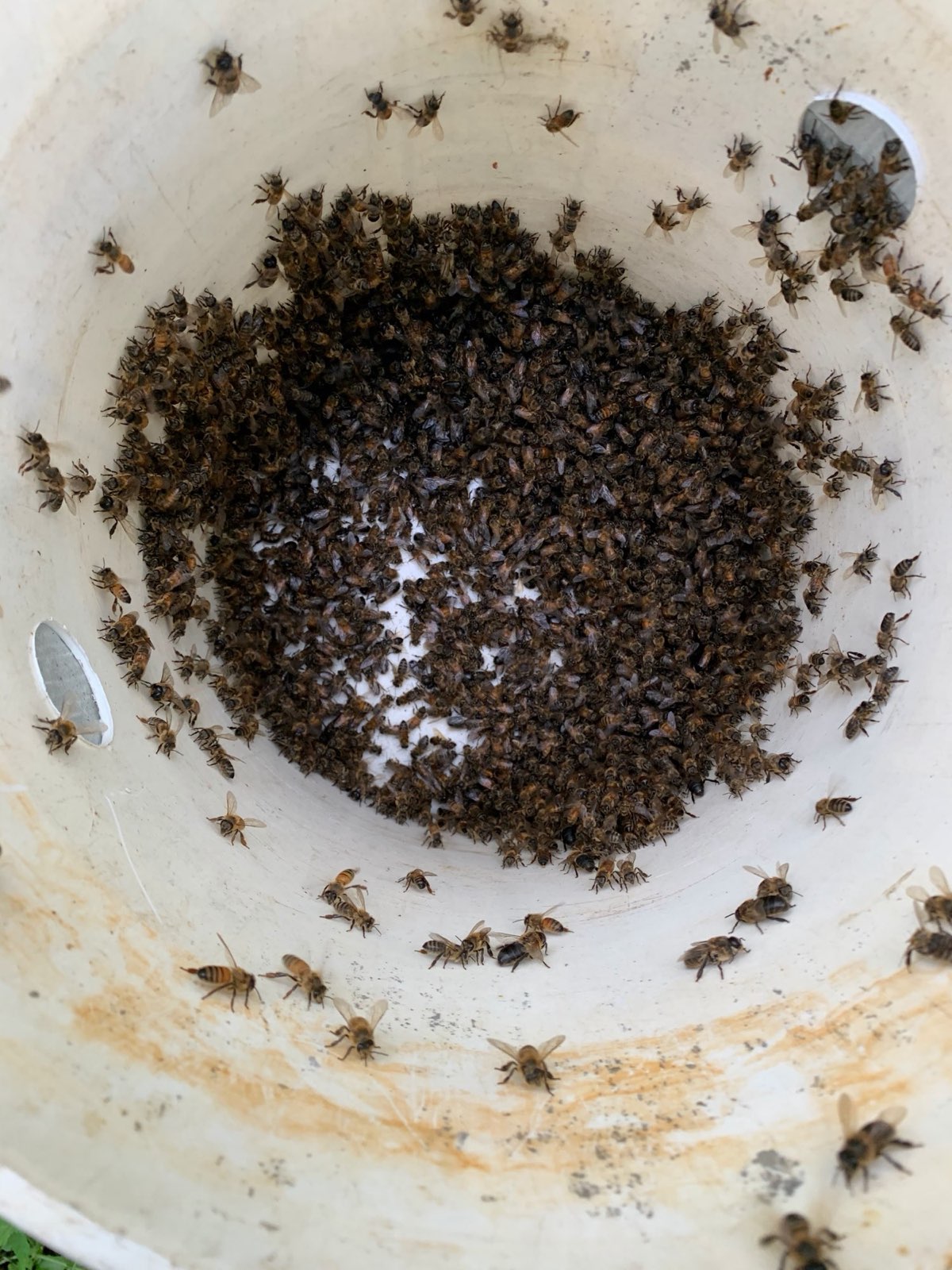
That's a swarm — a temporary cluster looking for a new home. Docile, but typically leaves within 24–72 hours if not collected. Don't spray, don't knock down, don't try to capture yourself. Call us right away. Swarms are collected free of charge.
Bees coming and going from a hole in a wall, soffit, or tree
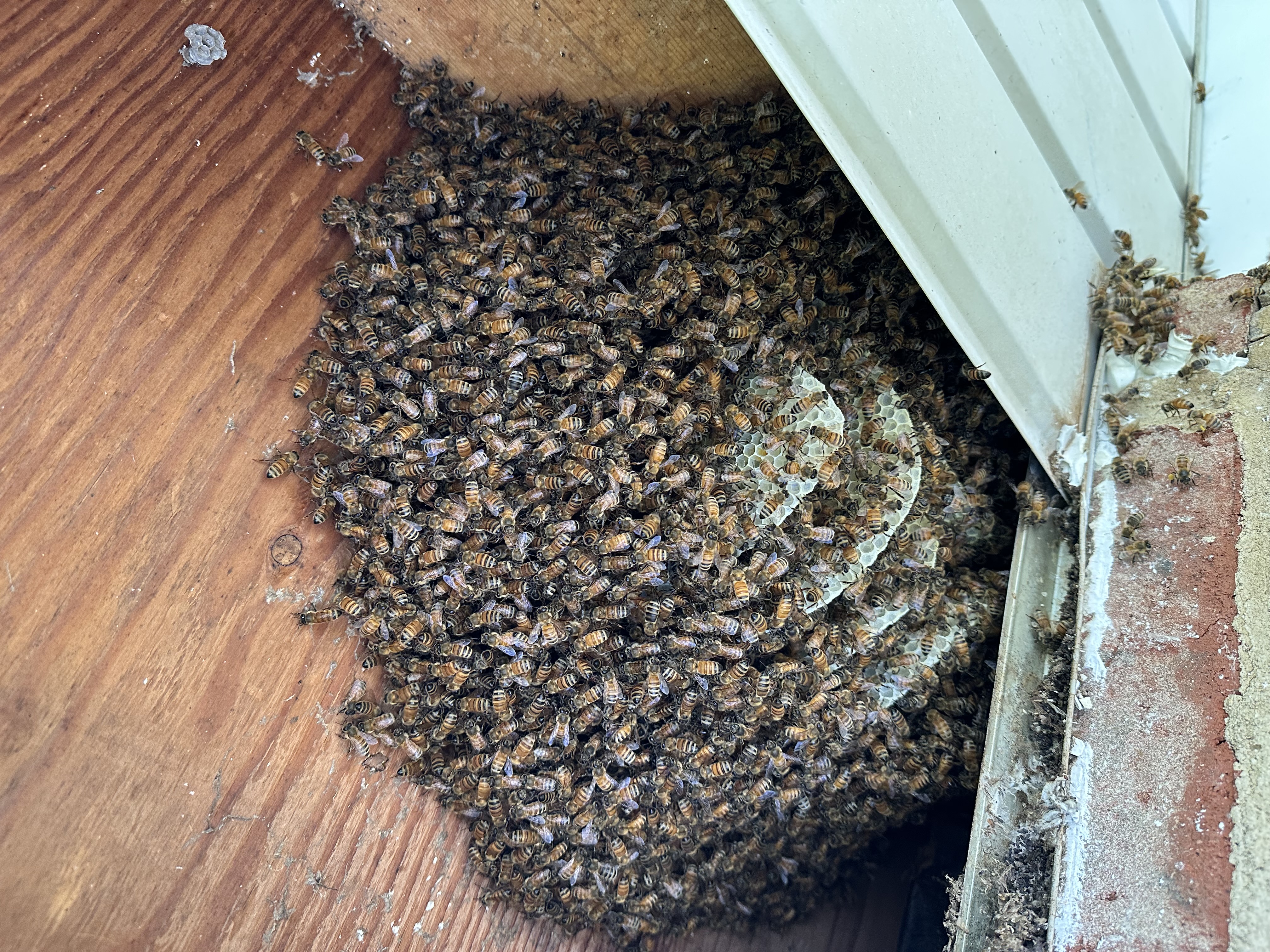
That's an established colony — comb, brood, honey, and thousands of bees inside. The longer it stays, the bigger and harder to remove. We provide free on-site estimates and remove the colony alive using bee vacuums and careful comb extraction. We also seal the entry point so a new swarm doesn't move in next spring.
Pick your situation
Bees in a wall, brick, or siding
Traffic disappearing into siding gaps, mortar holes, or brick weep holes. What's happening in the wall void and how live removal works.
Bees in the soffit
The most common structural bee call in Central PA. Why bees love the roofline and how we open, remove, and reseal.
Bees in the chimney
Bees around the flue or wandering into the fireplace. Why lighting a fire is the worst move, and how removal and capping work.
Swarm hanging on a branch
A ball of bees in a tree, on a fence, or on the swing set. Docile, temporary, and collected free — if you call before they move on.
Swarm on a bush, fence, or your car
A cluster at chest height, on the playset, or wrapped round a wing mirror. The easiest collection there is — and the one to call about today.
Bees living in a tree
Traffic in and out of a knothole means an established colony, not a swarm. Often the right answer is to leave them — unless the tree is coming down.
Bees under a deck or shed floor
Low, dry, enclosed cavities are exactly what a swarm shops for. Good news: no ladder work, so these are usually the easiest removals.
Honey bees or yellow jackets?
One gets rescued, the other gets exterminated — and it decides what you pay. How to tell in about ten seconds.
Bumble bee relocation
Bumble bees aren't honey bees, but they're not pests either — and they're absolutely not something we exterminate. The Alleman Apiary will relocate bumble bee nests from your property to our apiary, where they'll continue to do what bumble bees do best: pollinate. We're one of the only operations in Central PA that handles bumble bees this way. Most pest control companies kill them. Most beekeepers won't touch them. We do.
What's a bumble bee doing in my yard?
Bumble bees are native Pennsylvania pollinators. Large, fuzzy, mostly black with yellow bands, and they're one of the most important pollinators of native plants, vegetable gardens, and fruit trees. A typical bumble bee colony has only 50–400 workers — small compared to the 2,000+ in a yellow jacket nest or 50,000+ in a honey bee colony.
Bumble bees usually nest in the ground — abandoned mouse holes, mulch piles, compost bins, under sheds, in railroad ties, in cavities under decks. They sometimes nest above ground in soffits, wall voids, or birdhouses, but ground nesting is more common. The colony only lasts one season — workers die in fall, and only new queens overwinter to start fresh colonies the following spring.
Are bumble bees aggressive?
No. Bumble bees are docile. They sting only if directly threatened — if you step on the nest entrance, mow over it, or stick your hand in. Working in your garden 10 feet away from a bumble bee nest is generally fine. Compare to yellow jackets, which actively defend a wide perimeter and will sting unprovoked.
That said: bumble bees CAN sting, and unlike honey bees, they can sting multiple times. If you have a known bee allergy, keep distance and let us relocate them.
Why we relocate instead of exterminating
Several Pennsylvania bumble bee species are in serious decline. The rusty-patched bumble bee is federally listed as endangered. Other native bumble bees are being considered for listing. Killing a bumble bee colony to make a yard "easier to mow" is a real loss — these are the bees pollinating local strawberries, tomatoes, blueberries, and native wildflowers.
When we relocate a bumble bee nest, the colony goes to our apiary where they live out their natural season pollinating our property and the surrounding area. The new queens that emerge in fall overwinter, and next spring there are more bumble bees in Central PA, not fewer.
How bumble bee relocation works
- Send us a photo at 717-379-3248. We confirm it's actually bumble bees (not yellow jackets, not honey bees, not carpenter bees) before doing anything else.
- We schedule a relocation. Bumble bee relocation is best done at dusk or in cooler morning temperatures when the foragers are inside the nest.
- We come out, locate the nest entrance, and carefully transfer the colony — comb, brood, queen, and workers — into a transport box. For ground nests this sometimes involves carefully digging out a small section of soil with the nest intact.
- The nest moves to our apiary. We give them an undisturbed location to finish out their season.
- If needed, we treat the old nest site after the colony is out. Once a colony is established at a location, surviving workers can revert to laying queens and re-found a nest right back in the same spot. After we've removed the colony alive, we sometimes spray the cavity or entrance to stop a new nest from starting up where the old one was. The colony itself is already safely at our apiary — the spot-treatment only affects the empty site.
Bee, wasp, or hornet? — quick identification
Most calls about "bees" turn out to be something else. Here's how to tell what you have. Send a photo to 717-379-3248 for a free, fast identification — but if you want to figure it out yourself first, this guide covers the most common stinging insects in Central PA.
Honey Bees
Fuzzy, golden-brown to amber-striped, about ½″ long. Visit flowers, ignore your soda and trash, don't bore into wood. Honey bees nest in cavities — hollow trees, walls, soffits, chimneys — and build wax comb. Nests are permanent and grow over years. We do: live removal and relocation. See Swarm Collection.
Bumble Bees
Large, fuzzy all over (including the abdomen), mostly black with yellow bands. ¾″ to 1″. Nest in the ground or occasionally in soffits. Small one-season colonies (50–400 workers). Native PA pollinators in decline. Docile. We do: relocate to our apiary (see above).
Carpenter Bees
Look like bumble bees BUT the abdomen is shiny and hairless. Bore round, half-inch holes into deck rails, fascia, beams, and exposed wood. Solitary. Not aggressive — males hover and bluff but can't sting. The problem is wood damage, not safety. We do: our sister business Lawns Plants & Pests LLC treats them as pests. Not relocated.
Yellow Jackets
Smooth and shiny (no fuzz), bright yellow and black. About ½″. Nest in the ground (old groundhog holes), inside wall voids, or in soffits. Aggressive around food and trash, especially late summer. Sting repeatedly. Colonies can hit 2,000–5,000 workers by fall. We do: these are pest insects, not pollinators. LPP handles treatment.
Bald-Faced Hornets
Large (¾″), black with a distinctive white face. Build the football-shaped gray paper nest you see hanging in trees, under eaves, or in shrubs. Aggressive when defending. We do: LPP handles treatment.
Paper Wasps
Slender body, long legs that dangle when they fly, brown to reddish-brown with darker markings. Build small umbrella-shaped open-cell nests under deck rails, eaves, mailboxes, and porch lights. We do: LPP handles treatment.
When in doubt — send us a photo. We identify stinging insects every day. Send a picture to 717-379-3248 with your text and we'll tell you what you have, which business handles it, and what your options are. Identification is always free.
Why honey bees should be relocated, not killed
Honey bees are pollinators worth protecting, so a colony we remove doesn't get killed — it gets relocated. We use bee vacuums that collect the bees alive, we save and reuse the comb where possible, and the colony goes into one of our hives to keep working. For honey bees, live removal is almost always a better outcome than a can of spray.
We've been doing this long enough to know how to read a colony, find the queen, and get them set up at the apiary so they survive the move. We also work alongside our sister company, Lawns Plants & Pests LLC, a licensed Pennsylvania pest control operation that handles yellow jackets, hornets, wasps, and other stinging insects that can't be relocated. So when you call about a "bee problem," you're getting a complete answer no matter what species you actually have.
Where we work
We respond to swarm calls and removal jobs throughout Dauphin, Cumberland, Lebanon, and York Counties — including Harrisburg, Paxtang, Penbrook, Steelton, Highspire, Middletown, Hummelstown, Hershey, Palmyra, Annville, Cleona, Lebanon, Grantville, Linglestown, Colonial Park, Susquehanna Township, Lower Paxton, Camp Hill, Mechanicsburg, Lemoyne, New Cumberland, Wormleysburg, Enola, Marysville, Halifax, Millersburg, Elizabethtown, Mount Joy, Mount Wolf, Manchester, Dillsburg, Carlisle, Boiling Springs, and surrounding Central Pennsylvania communities. Outside our range? Call anyway — we know most of the working beekeepers in Central PA and we'll connect you with the closest one.
How much does honey bee removal cost?
Honest answer: most live honey bee removals in Central PA range from $500 to $1,000+, with simpler jobs at the lower end and complex structural work at the higher end. We don't quote a flat rate sight-unseen because every situation is different — a swarm in a tree (which we collect free) is a completely different job than a colony established inside a second-story wall void with three years of accumulated comb.
Lower-end factors
- Accessible location (ground level or step-ladder reachable)
- Recently established colony (smaller comb footprint)
- Single point of entry, easy to identify
- Standard residential structure (siding, simple soffit)
- No major comb removal required
Higher-end factors
- Second-story or higher locations requiring extension ladders or scaffolding
- Established colonies with extensive comb (often years old)
- Multiple entry points or complex cavity geometry
- Stucco, brick veneer, or hard-to-access cavity types
- Significant structural opening required (drywall, soffit panels, siding)
- Major cleanup of comb, honey, and dead bees
We provide free on-site estimates before any work begins. You'll get a clear, written quote with the scope and price spelled out — no surprise add-ons after the job. If structural repair (replacing siding, drywall, insulation) is part of the work, that's quoted separately or referred to a contractor depending on what's needed.
Bee removal FAQ
Will you really come collect a swarm for free?
Yes. Healthy swarms are valuable to a working beekeeper — they're how apiaries grow. We collect swarms at no charge, low or high. See Swarm Collection.
How long does swarm season last?
In Central PA, swarm season runs roughly April through early July, peaking in May and early June. Late-season swarms happen but are less common. Once you see a swarm, you have hours to days — not weeks — before they move on, so don't wait to call.
What does the removal process look like for bees in a wall?
We arrive in bee suits with a bee vacuum, smoker, and tools to open the structure. We locate the colony (sometimes with a thermal camera or stethoscope), open the wall just enough to access the comb, vacuum the bees alive, cut and save usable comb, and seal the entry point. The bees and salvageable comb come back to our apiary the same day. The structural opening is your responsibility to repair, but we leave it clean.
What happens to the bees after you take them?
They go to one of our managed apiaries in Central Pennsylvania. We inspect them, treat for varroa mites if needed, give them a new hive box with frames (and salvaged comb when possible), and let them settle in. Most colonies recover from the move within a few weeks and many produce honey their first season with us.
Are honey bees endangered?
European honey bees aren't formally endangered, but managed colonies have been struggling for decades with varroa mites, viral diseases, pesticide exposure, and habitat loss. Every saved colony matters — for the bees, for local food production, and for the gardens, orchards, and farms they pollinate.
Can I keep the bees you remove from my house?
Possibly — talk to us. If you have an interest in becoming a beekeeper, we can sometimes set you up with the colony we just removed and help you get started. We also offer beekeeping mentorship and starter equipment.
Same-day response in swarm season
Free estimates on structural removals. Bees relocated to working apiaries in Central Pennsylvania — never exterminated.
Call or Text 717-379-3248